Missed the webinar? Here are Investing.com’s top 10 stock picks for 2026

On Sunday afternoon, President Trump told reporters that he knew who he was going to officially pick to succeed Jerome Powell as Federal Reserve (Fed) Chair when Powell’s term expires in May 2026. While the formal announcement hasn’t been made, the favorite to take over the job, pending congressional approval, is current White House National Economic Council Director Kevin Hassett.
Market reaction has been relatively muted, with the Treasury yield curve steepening as short-term yields fell on expectations of more aggressive rate cuts, while inflation break evens widened marginally, reflecting mild concern that policy accommodation could outrun the data. Hassett, a longtime advocate for lower interest rates to support growth, has emphasized in recent interviews that the Fed should prioritize maximum employment and act decisively when growth slows — language that echoes the dovish tilt markets now price in.
This leadership transition arrives at an important moment for one of investors’ most enduring questions: can bonds still serve as a portfolio diversifier after the 2021–2022 inflation shock temporarily broke the negative stock-bond correlation?
The relationship between stock and bond returns stands as one of the most consequential dynamics in modern finance, fundamentally shaping portfolio construction and risk management for investors worldwide. In late 1997, this relationship underwent a historic transformation — the correlation shifted from positive to negative, where it remained for over two decades. However, the inflation surge of 2021–2022 and the subsequent positive correlation between stocks and bonds has sparked debate about whether we’ve witnessed the end of an era.
This shifting correlation became the bedrock of the classic 60/40 portfolio, allowing bonds to function as hedges against equity volatility. Bonds are not negatively correlated with equities, per se. But what they have been correlated to (and what we believe they will continue to be correlated with) is the business cycle and more specifically with economic growth shocks. And that correlation fundamentally changed in 1997.
The stock/bond relationship fundamentally shifted in 1997 because of the Great Moderation, financial market development and derivatives growth, globalization and capital flows, behavioral and institutional changes, and — most critically — the Fed’s reaction function change that began with the 1987 crash response and became known as the “Greenspan Put.” As markets became conditioned to believe that the Fed would backstop markets through a countercyclical monetary policy response (a response that was further reinforced after the 1997 Asian Financial Crisis and the 1998 Long-Term Capital Management bailout), the stock-bond correlation shifted and has become highly correlated with the Fed’s expected responses to market stresses.
Stock-Bond Correlation Has Become Highly Correlated to the Fed’s Reaction Function
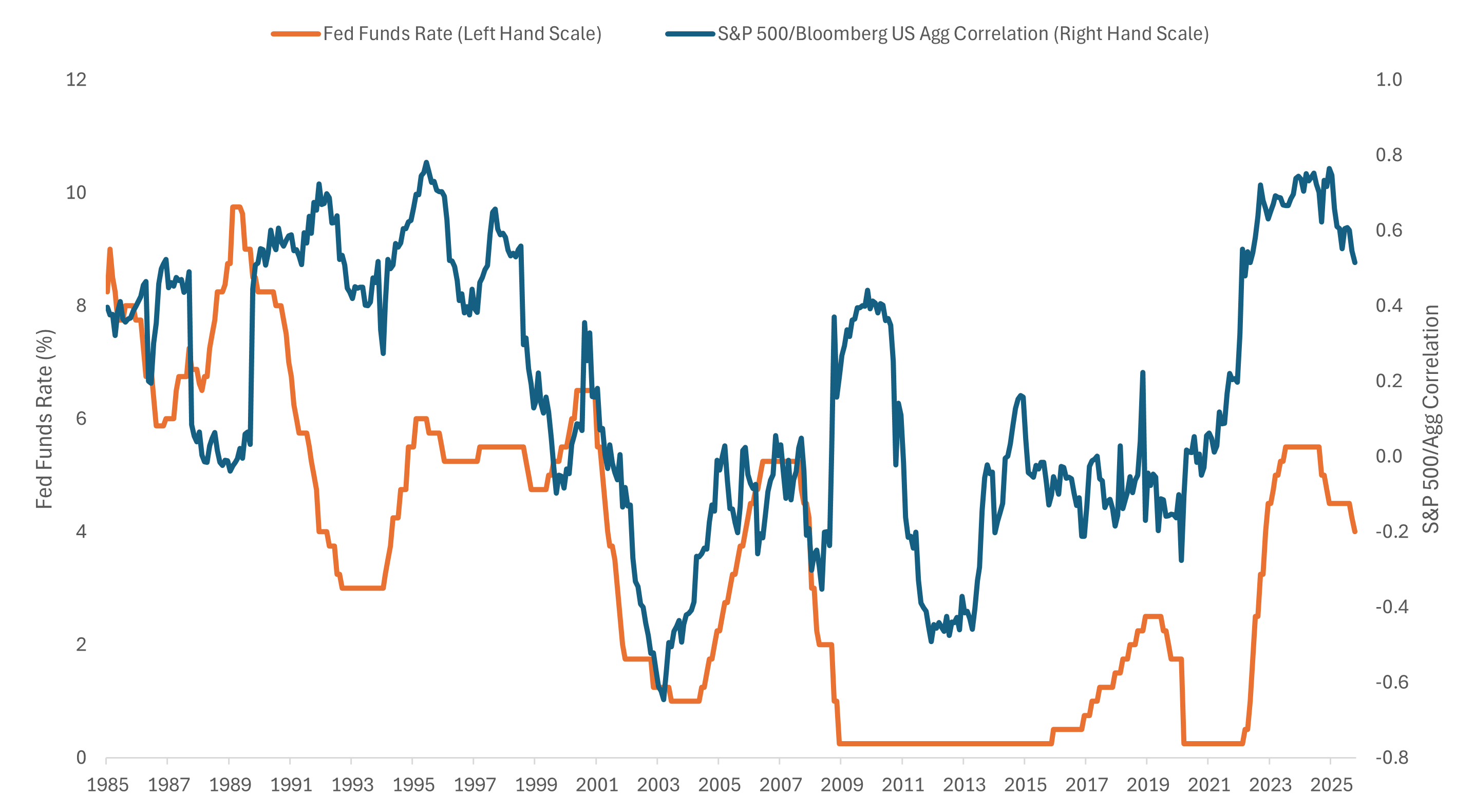
Source: LPL Research, Bloomberg 12/02/25
The post-pandemic inflation surge seemed to challenge this established order, but the Fed’s aggressive response to inflation in 2022–2023 actually reinforced its commitment to price stability. Inflation expectations have declined meaningfully from their 2021–2022 peaks and are converging toward the 2% target. The flight-to-quality mechanism remains structurally intact, and most recessions and equity bear markets are triggered by growth shocks — precisely the environment in which investors flee equities for the safety of government bonds and the Fed cuts rates.
While the 2021–2022 period challenged the negative correlation regime, the drivers that established it in the late 1990s remain intact: credible central banks committed to price stability, low steady-state inflation, growth shocks dominating recessions, and the unmatched safe-haven role of U.S. Treasuries. For investors, core principles of diversified portfolio construction remain sound. Bonds continue to serve as a ballast against equity volatility, especially during growth shocks and financial stress. The 60/40 portfolio certainly stumbled in 2022, but it is still an important framework.
With Kevin Hassett now expected to lead the Fed, the central question is whether that credibility will endure. Markets appear willing to give him the benefit of the doubt — for now — but any perception that policy will systematically favor growth over price stability could risk unanchoring expectations and potentially impair the reasons why bonds have become an effective portfolio diversifier over the past quarter century.
***
Important Disclosures
This material is for general information only and is not intended to provide specific advice or recommendations for any individual. There is no assurance that the views or strategies discussed are suitable for all investors. To determine which investment(s) may be appropriate for you, please consult your financial professional prior to investing.