SoFi stock falls after announcing $1.5B public offering of common stock

Introduction & Market Context
Virgin Galactic Holdings Inc (NYSE:SPCE) presented its third-quarter 2025 earnings results on November 13, highlighting progress in spacecraft manufacturing while reporting minimal revenue as the company continues its pre-commercial phase. The stock closed at $3.62, falling 8.15% following the earnings release, reflecting investor concerns about the extended timeline to commercial operations.
The space tourism company remains focused on developing its fleet of spacecraft, with commercial operations targeted to begin in Q4 2026. Currently trading closer to its 52-week low of $2.18 than its high of $7.995, Virgin Galactic faces the challenge of maintaining investor confidence during this capital-intensive development phase.
Quarterly Performance Highlights
Virgin Galactic reported revenue of just $0.4 million for Q3 2025, derived primarily from access fees related to future astronaut bookings. While revenue remains minimal, the company showed improvement in cost management, with total operating expenses decreasing to $67 million, down from $82 million in the prior year.
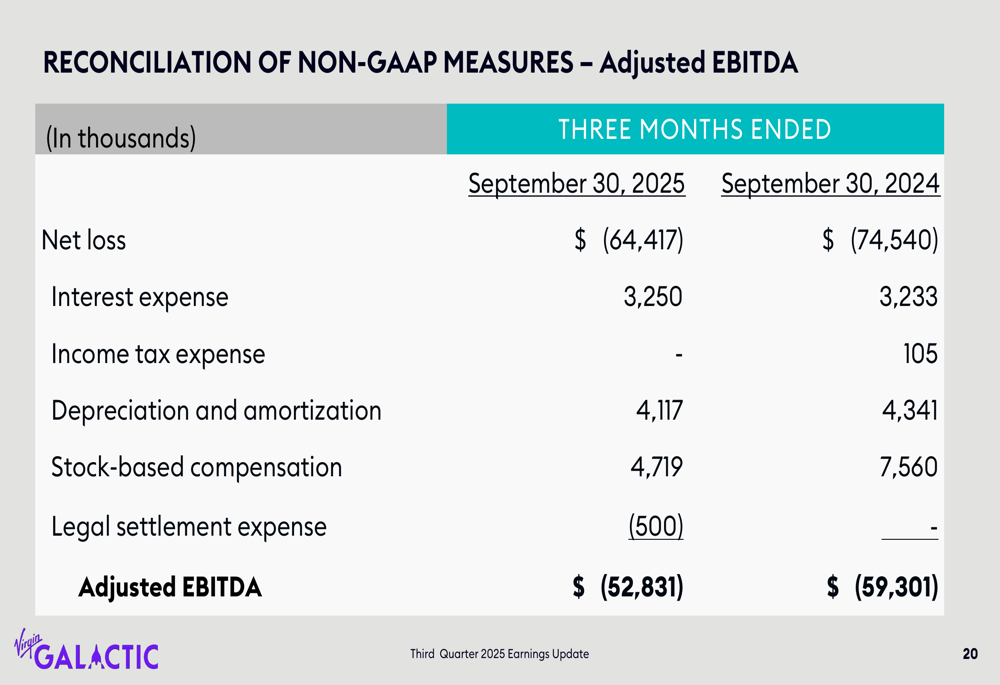
The company posted a net loss of $64 million, an improvement from the $75 million loss in Q3 2024. Adjusted EBITDA was negative $53 million, compared to negative $59 million in the prior year, representing an 11% improvement.
As shown in the following financial results summary:
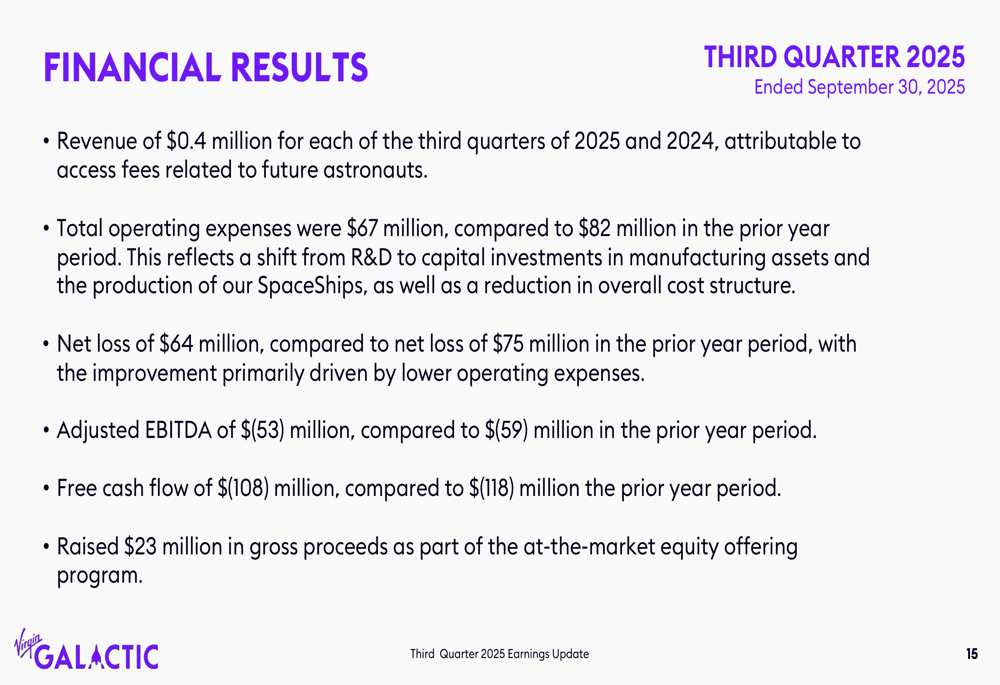
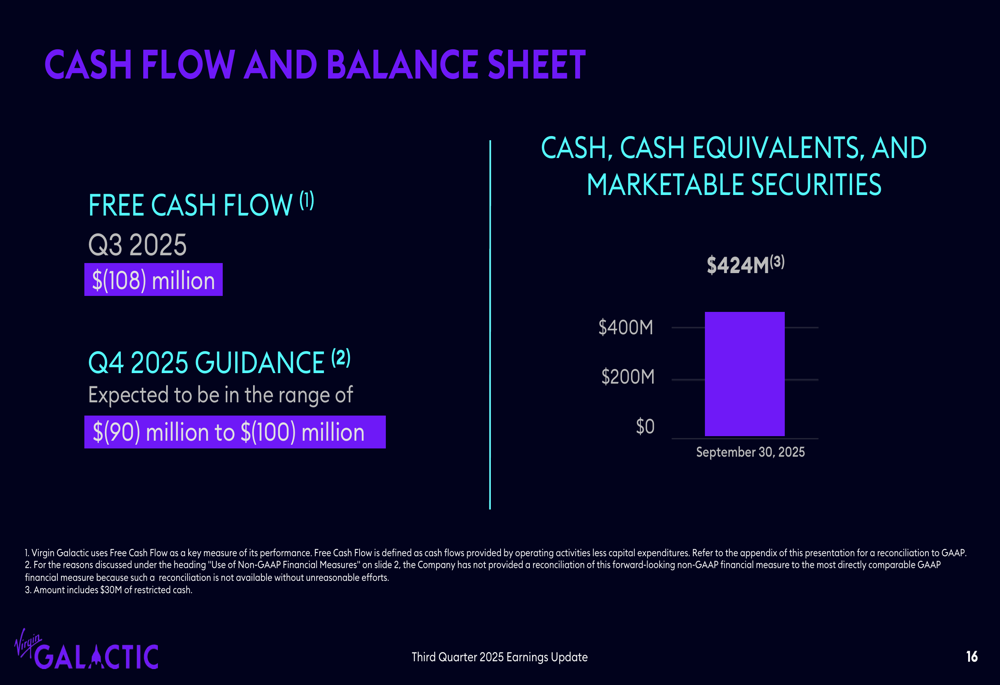
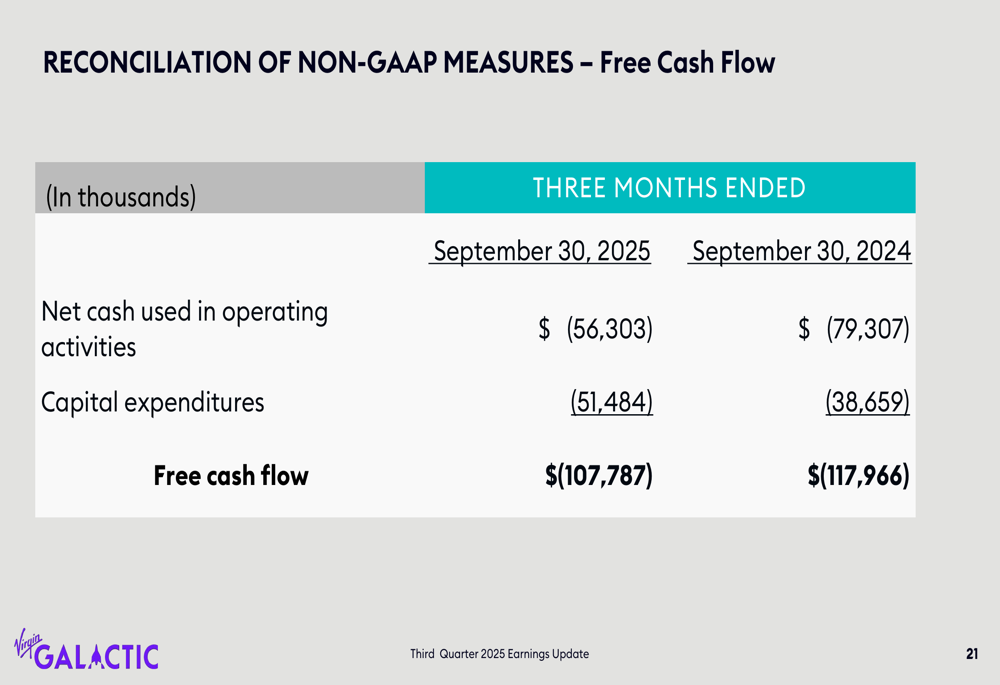
Free cash flow for the quarter was negative $108 million, showing a modest improvement from negative $118 million in the same period last year. The company's cash position stood at $424 million as of September 30, 2025, bolstered by $23 million raised through an at-the-market equity offering during the quarter.
Spacecraft Development Progress
Virgin Galactic's presentation heavily emphasized progress in spacecraft manufacturing, with detailed updates on various components of their next-generation spaceships. The company continues to document its manufacturing journey through a "We Build Spaceships" video series, highlighting different aspects of the construction process.
The presentation showcased the company's progress on key spacecraft components, including the wing, feather system, fuselage, and oxidizer tanks. These visual updates aim to demonstrate tangible progress toward completing the spacecraft needed for commercial operations.
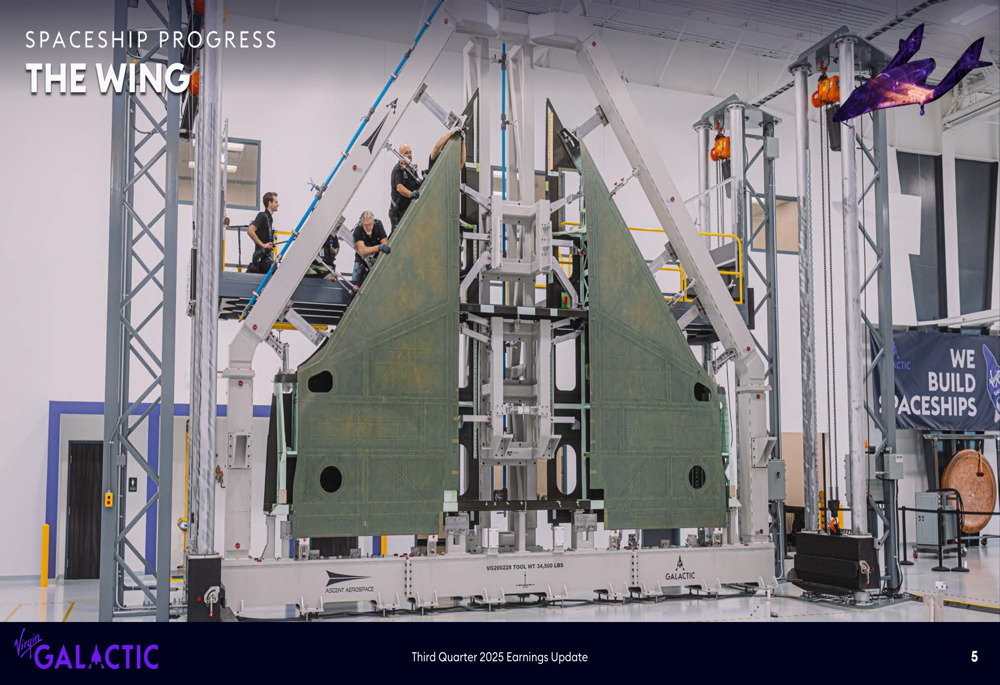
As shown in the following image of wing assembly progress:
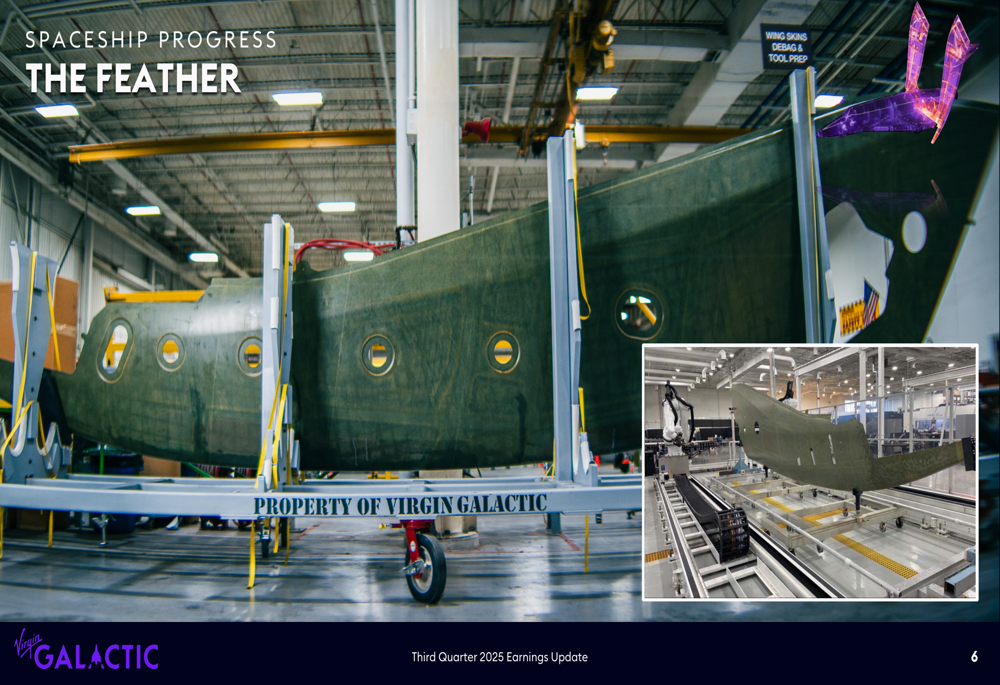
The company also highlighted development of the spacecraft's distinctive "feather" system, a critical component that enables the safe re-entry of the vehicle:
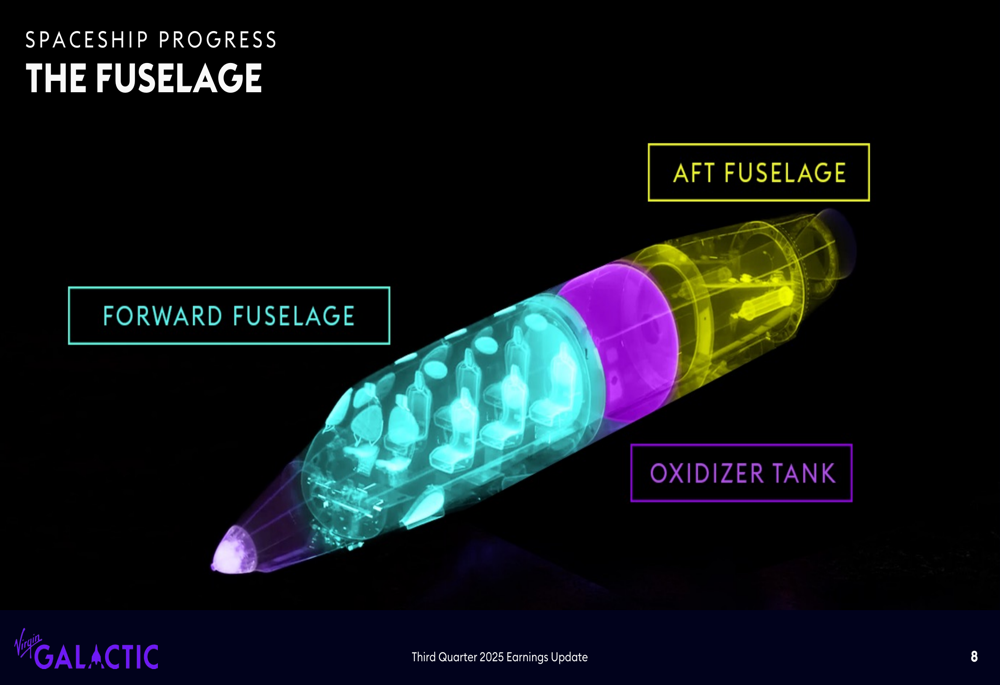
The fuselage development was illustrated through translucent representations showing the various components and their integration:
Detailed Financial Analysis
Virgin Galactic's financial statements reveal the significant ongoing investment required to develop its spacecraft fleet. The reconciliation of non-GAAP measures shows the components of the company's Adjusted EBITDA calculation:
Similarly, the free cash flow reconciliation demonstrates the substantial cash burn rate as the company continues to invest in capital expenditures:
For Q4 2025, management guided for free cash flow to be in the range of negative $90 million to negative $100 million, suggesting a slight improvement in cash burn rate compared to Q3.
Long-term Economic Model
Despite current losses, Virgin Galactic presented an optimistic long-term economic model based on fleet expansion at Spaceport America. The model projects significant revenue growth and profitability once commercial operations scale up.
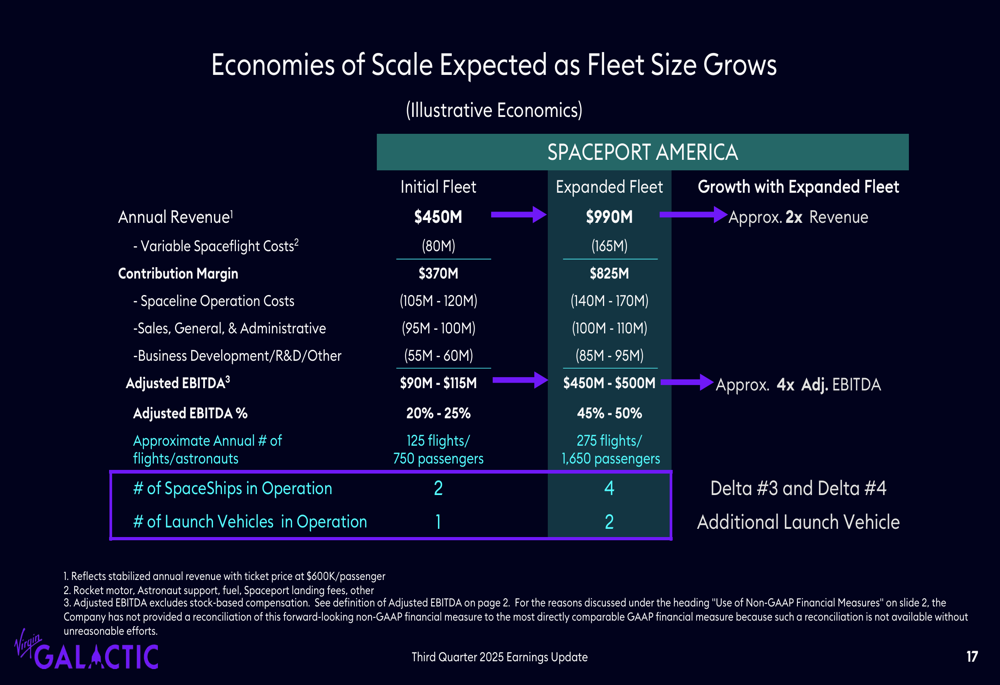
According to the company's projections, an initial fleet consisting of two spaceships and one launch vehicle could generate approximately $450 million in annual revenue from 125 flights carrying 750 passengers. This is expected to yield an Adjusted EBITDA of $90-115 million.
More impressively, an expanded fleet with four spaceships and two launch vehicles could potentially generate $990 million in annual revenue from 275 flights carrying 1,650 passengers, with Adjusted EBITDA reaching $450-500 million.
The following slide illustrates this projected economic scaling:
Forward-Looking Statements
Virgin Galactic continues to target Q4 2026 for the launch of its commercial spaceflight service, with most current customers expected to take their journeys during 2027. This timeline suggests at least another year of pre-revenue operations and continued cash burn.
The company's economic model hinges on successfully completing spacecraft development, obtaining necessary regulatory approvals, and executing a smooth commercial launch. While management remains confident in their ability to achieve these milestones, investors appear concerned about the extended timeline and ongoing capital requirements.
Virgin Galactic's ability to manage costs while maintaining development momentum will be crucial in the coming quarters as it works toward transforming its manufacturing progress into commercial reality. The market reaction to the Q3 results suggests investors remain cautious about the company's path to profitability despite the visible progress in spacecraft development.
Full presentation:
This article was generated with the support of AI and reviewed by an editor. For more information see our T&C.